Art, Colonialism, and Academic Collections
5-16 October 2026 Lichthof Ost, Humboldt-Universität zu Berlin
This exhibition shows works inspired by academic collections and seeks to trace colonial violence, imperial overlaps, and how the past reaches into the present.
Gesa Stedman, who also curated the exhibition, worked on a navigation chart from the Marshall Islands which is held at the Pitt Rivers Museum, Oxford, and whose provenance is linked to the German as well as the British Empire.
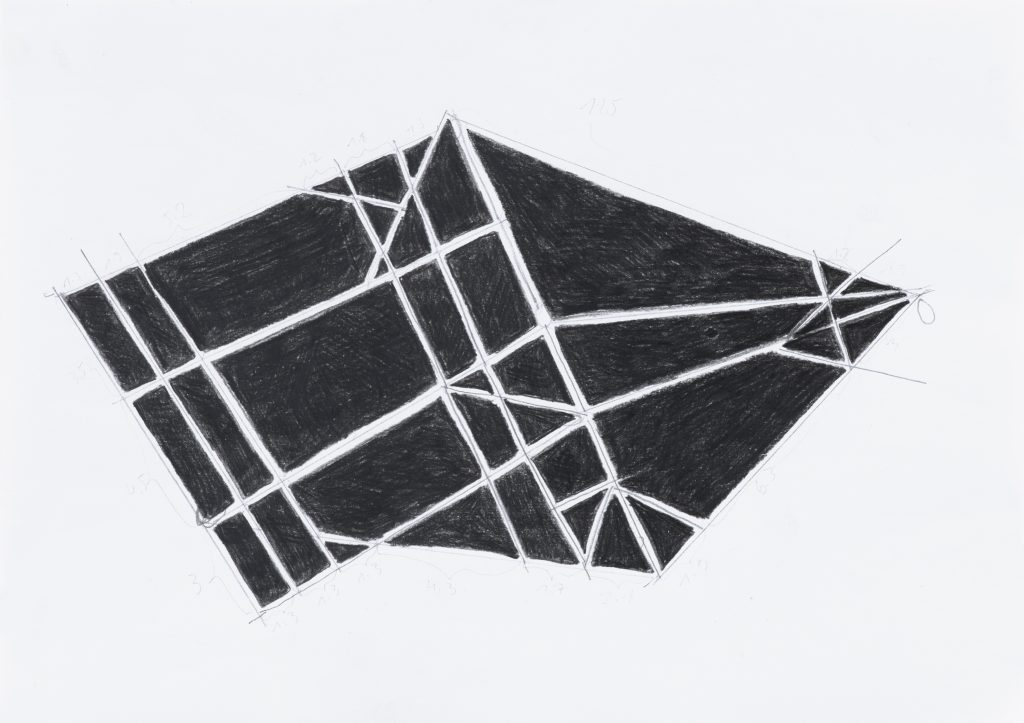
Sailing Chart, 2026, coloured pencil on paper
Photo: Eric Tschernow
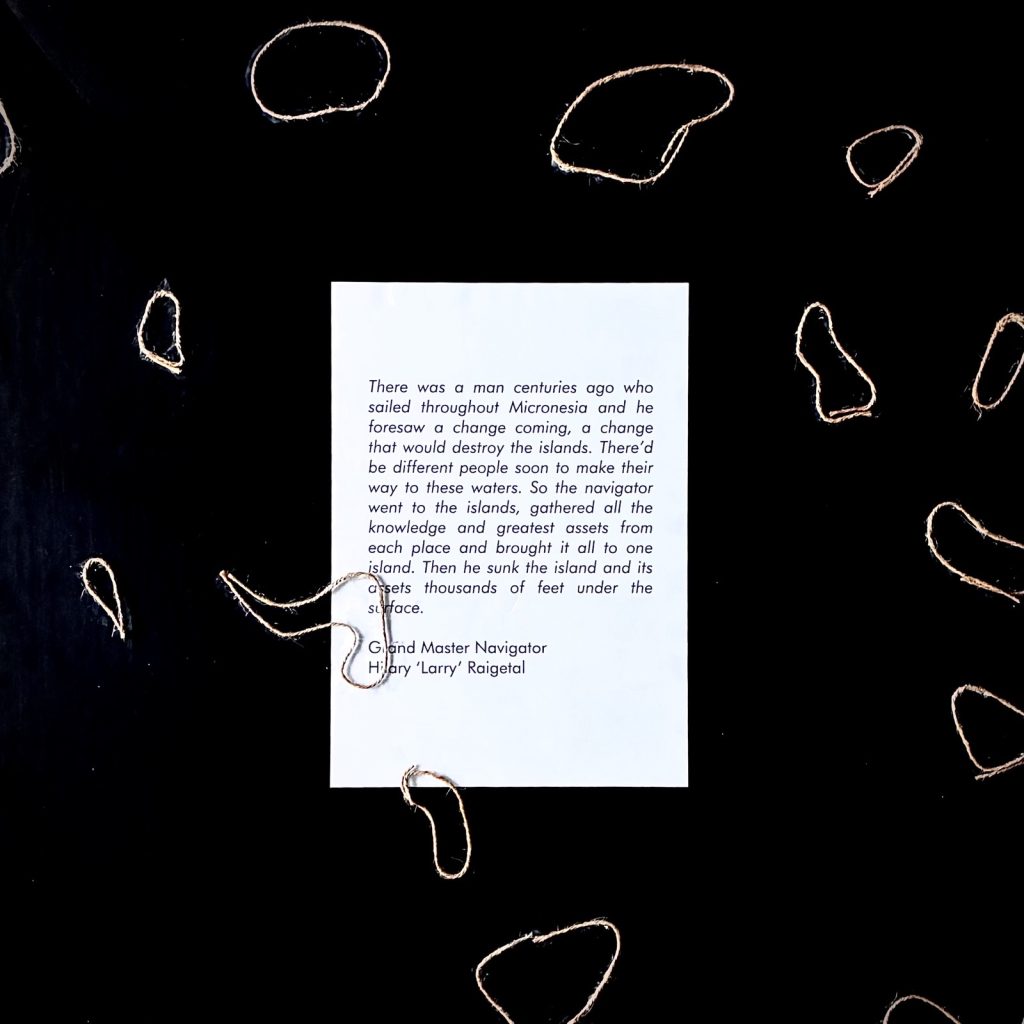
Photograph: Liam Stedman
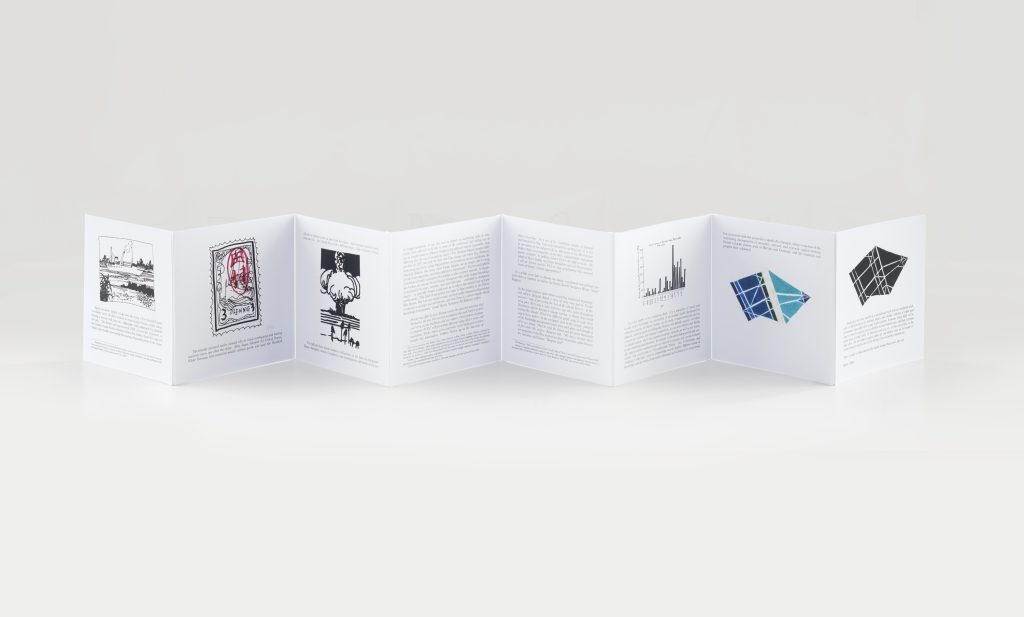
photograph: Eric Tschernow
Grand Master Naviagor Alson Kelen kindly agreed to be interviewed by Gesa Stedman summer of 2026. This is the unabridged version.
- Many Western museums hold navigation charts (the Pitt Rivers, Oxford, The Smithsonian, Washington, the British Museum, London, the Humboldt Forum, Berlin etc.). Are there any such charts in the Marshall Islands?
These charts are also displayed in many museums across the US, the Pacific, and Asia, as well as in all of our [Marshall Islands] embassies and consulates around the world. These are the unique symbols of our unique heritage. And yes, these are common in the country, but unfortunately, not too many people can still read the unique wooden characters and what they represent. The trainers in our canoe program [can] (Waan Aelõñ in Majel – Canoes of the Marshall Islands: www.canoesmarshallislands.com www.facebook.com/wam.rmi/)
- Does one know whether the charts in ethnological museums in the West were stolen or bought or forcefully taken in some other way?
As far as I know, these were gifted to the visitors by our chiefs. These are learning tools; so, like other Pacific Islands, the young apprentices memorize them so they don’t take them on voyages. Today, these are given to visitors by our people, even by political leaders and our chiefs, as a gesture of friendship.
- What is your opinion about the fact that most of these charts are presented as objects, rather than as very sophisticated, abstract works of art (with a practical, equally sophisticated use)?
The written documents I’ve read from the Germans were based on the translation and on how they heard the words. Because our heritage was passed down orally from generation to generation, whatever was written might have changed over time, location, dialogue, and, in some cases, [even] the size of the person interviewed. I know a couple of these big documents that still haven’t been translated to this day, so maybe more of them can be very useful for us today. I’ve seen that most of the words in the documents were spelled according to how they were heard. Example: MEDDO is one of the stick charts, but the actual spelling is METO, which also means ocean. We are called RiMeto, which means ocean people or navigators. We were fortunate to work with some of our culture-keeper elders, and they were able to make corrections in many cases.
- How would you like to have these charts presented, if one imagines them still in these museums?
Larry [Raigetal, Grand Master Navigator] and I gave a presentation at Stanford University a couple of years ago, and at the end, we displayed our navigational stick charts and star map in their Map Museum. Last year, I spent most of July at the Humboldt Forum, learning and assisting with a traditional canoe that had been taken there in 1813. We measured our canoe there using sophisticated laser measurements, 3D-printed it, and I brought it home. Our boys then built a traditional breadfruit wooden canoe from it, including the traditional mat sail that was displayed at the museum. Our students were able to reweave this lost art of the woven sail. The canoe is now on display at our mini traditional maritime display center here at our program.
- Would you prefer they were restituted and copies kept in the museums instead?
I think the original ones collected previously should be kept in museums and other places for safekeeping. I believe we should share these traditional technologies with our youth programs and even develop a curriculum for schools to gain interest among youth. Some students might be able to modernize them and use them for other purposes with current technology. With the changes of the climate and redirection of our swells, and ocean currents, we might find that a stick alignment or curvature might need reshifting or resizing, etc.
- Has nuclear fallout changed navigation?
The nuclear testing in the Republic of the Marshall Islands did a huge damage not only to navigation skills, but also to many other traditional skills that we depended on for our survival. Many people from the northern Marshall Islands were relocated to places so different from their homeland that these knowledges were not practiced, and they gradually were lost. I am from Bikini Atoll, which was a nuclear testing site; my people were relocated in 1946 to a small island surrounded by a reef and rough seas most months of the year. So, canoe building was not practiced.
- Recently, a generation of new young wayfarers has been accepted as navigators. How much interest do younger people show in navigation knowledge in the Marshall Islands and Micronesia, and how do younger people put this knowledge to use?
First, the Marshall Islands is a country in Micronesia. Larry [Raigetal] can share his thoughts on his part of Micronesia, but I would say that youth in my part of Micronesia have mixed interest in traditional navigation. When it comes to traditional navigation, cultural pride fosters positive self-esteem. In the past, it was a skill on which our survival depended. We were migrators; our islands are atolls, so we can’t depend on any single island to sustain our lives. Yes, these are important skills to hold on to, but we need to do so in a way that meets modern expectations. Here are the structures and formats we’re using to build our curriculum and teaching approach. Keep in mind that we work mostly with at-risk and dropout kids. We make sure that canoe building is a major part of the studies, but literacy, numeracy, and science are also included so that, in the end, the kids are eligible to enter GED courses. We’re also working with the Maritime Training Center at the College of the Marshall Islands to add traditional sailing to their courses so it becomes accredited. We’ve also had university students learn and do research on this skill for their Master’s and PhDs. Some of our students are now working in the maritime sector, and a couple of them are ship captains.
- What do you think about the Polynesian Voyaging Society and the way they present themselves as the just heirs to navigation knowledge?
I think it’s like a picture frame: we are looking at the picture from a different angle and offering our explanation based on what and how we see it. The story I’ve heard is that our grandmaster navigator shared his knowledge with our brothers from Polynesia, who modernized the training process. Many of the students in the Polynesian format use these skills in their areas of interest, whether it’s oceanography, marine science, or other environmental studies, including climate change. Unlike most of us in the islands, we still use these skills for our daily survival. See, in the Marshalls, there are many other elements to the process even before one learns the skill.
- What do you think about the way the Disney film production for the film “Moana” represents navigation? (I haven’t seen the film myself, only read and heard about it so my own knowledge how the film uses this knowledge is based on texts, and accounts of people who have seen it, not on the film itself).
I was asked this question a couple of years before my granddaughter and I watched and memorized some of the songs and dances. So when I was asked, I said, “My granddaughter and I loved it.” I did not focus my answer on the details in the cartoon movie; I thought it was a great piece of entertainment for a family gathering. My granddaughter told her classmates that her grandfather was Maui. Many of my friends were disappointed with how it was told. When the second one came out, other friends were not satisfied.
- What would be the best way to explain to Western people how knowledge is imparted in your islands, how it is memorised, and how it is kept alive?
Our knowledge was and remains part of our existence. We have to live it and keep it alive, which is sometimes challenging when Western conveniences and lifestyles collide with it.
- What role do current ethnologists play in experimenting with traditional wayfinding and do they approach you and your colleagues with their projects and include you in their plans?
I think the best approach to anything that belongs to the indigenous communities is to come respectfully, ask for permission to proceed, and ensure they are acknowledged virtually, verbally, and in any written documents. I also believe that documenting any traditional knowledge is essential now, as some of our culture keepers are still alive.
- Do you think any of these projects will help alert people that climate change is threatening Micronesia?
A good example is our canoe-building skills training, which is essential to include in both our formal and informal curricula. As gasoline prices are skyrocketing around the world, we should rely on our traditional crafts, a tool we’ve used since we arrived on these shores. Our small countries are rich with three things – sun, wind, and ocean. So, why look abroad when the solution is here?
- What else could/should former colonising countries do in your opinion?
Support our EFFORTS to live sustainably, otherwise we’ll be spoon-fed forever.
- What message would you like to leave for the audience who have come to see “Uncomfortable Truths – Art, Colonialism, and Academic Collections” at Humboldt-Universität Berlin in Germany?
Speaking from a small coral atoll nation with a rich oral history, I am truly grateful that many of our ancestral tools are now preserved and displayed around the world. These are treasures that, only a few years ago, we knew little about — what they looked like, how they were crafted, or the stories behind them. Today, they continue to teach, inspire, and reconnect us with the wisdom and skills of our ancestors.
I believe we should make use of these opportunities by sharing these cultural items with our communities and supports efforts to discover what else may still be out there. While many of these traditional tools may no longer serve practical purposes in our modern society, they can certainly inspire new fields of study and learning opportunities for our young people, reconnecting them with the knowledge, creativity, and history of our ancestors.